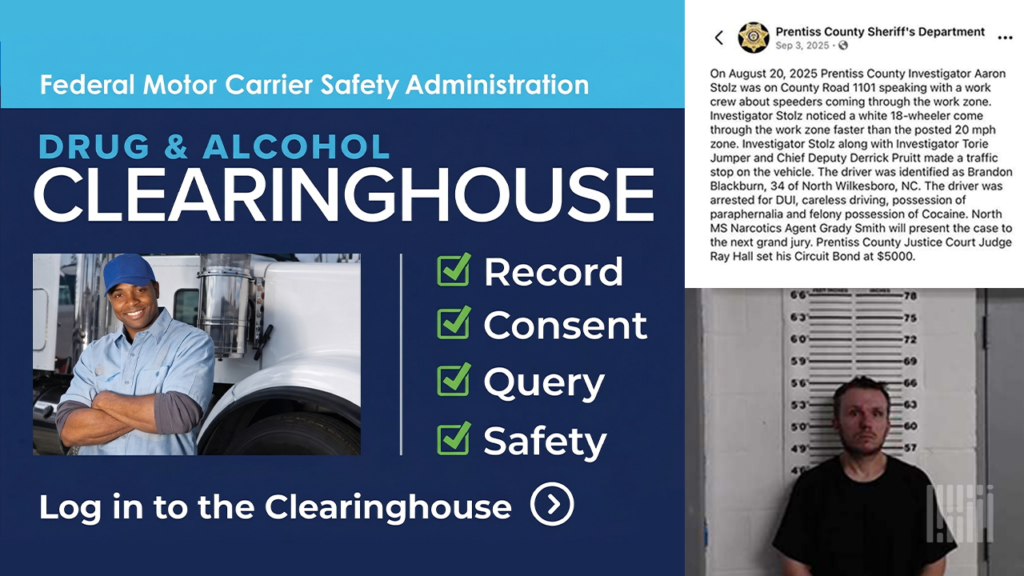
There is a federal database sitting between a drug-positive commercial driver and the roads you drive on every day. It is called the FMCSA Drug and Alcohol Clearinghouse, and it is supposed to be the last line of defense between a CDL holder with a substance abuse violation and the cab of an 80,000-pound truck.
Someone figured out how to beat it. One in every 85 CDL drivers who completed the federal return-to-duty process and were cleared to operate a commercial vehicle may have been cleared by a truck driver from North Wilkesboro, North Carolina, who was pretending to be a self-certified SAP and registered as one.
Not a doctor. Not a licensed counselor. Not a psychologist, a social worker, or a certified addiction professional. A truck driver. One who was arrested in August 2025 in a Mississippi construction zone while impaired, with cocaine in his possession, falsifying his own federal logbook records, the same day he was sending green checkmarks to drug-positive CDL drivers across the country via Facebook Messenger and collecting $100 a driver via Zelle.
His name is Brandon Blackburn, 34, of North Wilkesboro, North Carolina. He solicited clients through SAP-focused Facebook groups, including SAP Drivers USA, a community of more than 1,300 CDL drivers navigating drug violations, where he held an “All-star contributor” badge and operated openly through private Facebook Messenger conversations. He registered in the FMCSA Clearinghouse as a Substance Abuse Professional. He is not one. He never has been. According to evidence we reviewed, including Facebook posts, private message screenshots, payment confirmations, and federal Clearinghouse records, Blackburn spent years charging CDL drivers $100 to $350 to fraudulently enter completed return-to-duty steps inside the federal database, making it appear that prohibited drivers had finished a legally mandated recovery process they never went through.
By his own boasting, he did this for more than 600 drivers. Law enforcement and investigative sources put the number closer to 1,000.
He is not the only one. FMCSA has known that this kind of fraud is happening. They documented it on their own official website. They directed victims to contact a help desk. They have not fixed the registration architecture that enables it.
Blackburn was arrested on August 20, 2025. As of the date of this publication, he is out on bond, awaiting trial, and still available to offer his services. Still peddling them on Facebook and messenger apps, getting paid $100 unless you have the $75 coupon via Zelle for two minutes’ worth of work.
On August 20, 2025, Prentiss County Investigator Grady Smith was speaking with a work crew on County Road 1101 when a white 2019 Freightliner Cascadia came through the construction zone at more than two miles per hour over the posted 20 mph work zone limit. Smith and his team stopped the truck.
Behind the wheel was Blackburn. The truck was owned by D. Kizer Enterprises of North Carolina, operating under the name Custom Transport Inc., a carrier that shares phone, email, address, and officers with what appears to be a tightly intertwined operation. The truck was insured by Canal Insurance Company. Canal dropped the carrier in January 2026.
Investigator Smith says Blackburn was “tweaking hard” when stopped. He was charged with DUI, careless driving, possession of paraphernalia, and felony possession of cocaine. Prentiss County Justice Court Judge Ray Hall set the circuit bond at $5,000. The case has been referred to the next grand jury.
His FMCSA inspection record from that same day tells the complete picture. Three violations appear: an ELD hours-of-service violation from August 2024, a violation under 49 CFR 392.4 for operating a commercial motor vehicle while in possession of drugs, and a violation under 49 CFR 395.8, “No driver may make a false report in connection with a duty status.” He was falsifying his own logbook records. The same day he was caught with cocaine in the cab of a truck, he drove through a construction zone while impaired.
This is the man who had been serving as a fake, self-attested SAP or Substance Abuse Professional for hundreds of CDL drivers.
Investigator Smith told us that he assumes Blackburn returned to North Carolina after posting bond and resumed driving a truck. He is correct in his assumption. The evidence reviewed for this article confirms that Blackburn continued to offer his SAP clearing services after his arrest.
This is not the beginning of his criminal history, which runs deep in NC.
The FMCSA’s own December 2025 Clearinghouse Monthly Summary Report (clearinghouse.fmcsa.dot.gov/learn/monthly-summary-reports), the most recent available, establishes the national context.
As of January 2, 2026, there are 328,431 CDL holders in the Clearinghouse with at least one drug or alcohol violation. Of those, 202,345 remain in prohibited status, legally barred from operating a commercial motor vehicle. Another 159,226 have not even started the return-to-duty process. The total violations reported to the system since January 2020 stand at 368,984, with positive drug tests accounting for 82 percent of that number.
The report shows 6,305 total SAP registrations in the Clearinghouse since the system launched in 2019. That is the entire national pool of accounts with SAP-level access, the accounts that can enter clinical assessment dates, log RTD eligibility determinations, and mark follow-up testing plans complete for hundreds of thousands of prohibited drivers.
Blackburn’s account is one of those 6,305. And, per the evidence reviewed for this article, none of the 6,305 registrations was verified against a state licensing database, a national credentialing organization, or any external record at the time of registration.
Cocaine Metabolite violations alone account for 57,075 of the positive tests in the system since 2020, the same substance Blackburn was carrying in his cab when arrested. Marijuana violations account for more than 206,000. Methamphetamine more than 29,000. Every one of those drivers has a violation in a federal database. Every one of them represents a potential customer for an operation like Blackburn’s.
The report further shows that 126,086 drivers have achieved not-prohibited status, meaning they have cleared the RTD process in the system. Of those, 85,136 have a logged negative RTD test result, and 40,950 have a logged follow-up testing plan completion. Nobody at FMCSA has audited how many of those entries were made by legitimate clinical professionals versus people like Blackburn, who checked a box and bought access to a federal database for the price of an email address.
Under 49 CFR Section 40.281, a Substance Abuse Professional must hold one of six qualifying credentials: a license as a physician, psychologist, social worker, or employee assistance professional; a state license or certification as a marriage and family therapist; or certification as a drug and alcohol counselor from a DOT-approved organization such as NAADAC or IC&RC.
That is the starting line. Beyond the credential, a SAP must demonstrate clinical experience in diagnosing and treating substance abuse disorders, complete a 12-hour DOT qualification training program covering 9 specific subject areas, pass a nationally administered examination, complete 12 hours of continuing education every 3 years, and maintain documentation of all of this on demand.
Consider what that looks like in practice. Paul Collette, a legitimate SAP and Licensed Alcohol and Drug Counselor who alerted authorities to Blackburn’s operation, holds an LADC credential. His DOT qualification certificate shows 16 CE credits completed through Program Services Continuing Education, a DOT-listed provider carrying certificate number CEB#20-10724, signed by a named Continuing Education Director. His NAADAC provider number is on file. His state credential is documented. His national examination is verified.
Brandon Blackburn is a truck driver. He holds none of those credentials. Not one. He checked a box saying he did, and the system gave him a dashboard.
The FMCSA Clearinghouse SAP registration is a five-step online process. A person creates a login.gov account, selects the Substance Abuse Professional role, enters their name and contact information, selects a credential type from a dropdown menu, and checks four boxes confirming they meet the knowledge, training, examination, continuing education, and documentation requirements of 49 CFR 40.281.
No verification. No cross-reference with a state licensing board. No call to NAADAC or IC&RC to confirm a certification number. No audit against any external credential database. The system accepts the attestation and grants full access to the SAP dashboard.
Step 10 of the official FMCSA SAP registration guide (available at clearinghouse.fmcsa.dot.gov/register) states simply: “Check the box to confirm that you are a credentialed SAP.” Steps 11 through 13 ask for contact information and four additional compliance checkboxes. You check them. The system moves forward. Nobody verifies anything behind you.
This is not a system that was hacked. This is a system designed with no verification layer that was exploited by someone willing to lie on a government form.
The evidence reveals two distinct schemes running simultaneously.
The first is what drivers were paying for: fraudulent clearance. A driver with a drug violation would reach out to Blackburn via SAP-focused Facebook groups or direct Facebook Messenger, hand over their name, date of birth, CDL number, and state of issuance, and within minutes, their Clearinghouse dashboard would flip. Six green checkmarks. “Your Clearinghouse record no longer prohibits you from operating a CMV.” Then: “What’s your CashApp?” or “u got CashApp or Zelle?”
Evidence reviewed includes a Zelle confirmation for $100 sent to “BRANDON BLACKBURN” following a clearance, with the driver responding, “Like for real. We all out here are soooo grateful and thankful for you. God bless you, Brandon.” Dozens of similar exchanges document the same pattern across multiple drivers, multiple states, and multiple months.
The pricing was $100 for steps 5 and 6, $350 for the full six-step clearance. Veterans, he advertised, were free. Weekend specials ran $75. He was running a retail operation inside a federal safety database.
The second scheme is what FMCSA documented in their own fraud alert: extortion. Drivers who were cleared and then blocked from Blackburn to dodge payment were sent back to Step 1. He posted about one case publicly: “he unblocked me real fast when I put him back on step 1.. Now it’s gonna cost him 250 instead of the 100 for me to remove it.” He admitted threatening “25 or 30 people that still owe me” with the same reversal.
He is operating the federal database as a personal ledger. Clear violations for payment. Re-impose them as collections. Both through a system that had no controls on either.
This is the part that every fleet safety manager, every insurance underwriter, and every carrier risk officer needs to understand clearly.
Step 5 of the return-to-duty process, the negative RTD drug test result, is an employer or C/TPA-reported entry in the Clearinghouse. It is a date field. An authorized user logs in and types the date of a negative test result. There is no lab report upload. No MRO push-confirmation. No specimen chain of custody record. No collection site verification. The system accepts a date and a checkbox for certification.
Step 6, the follow-up testing plan completion, is the same. A date field. A checkbox.
Blackburn was not forging a drug test result. There was no test to forge. He typed a date. The Clearinghouse accepted it. A driver who never approached a collection site now has a federal record showing a completed return-to-duty process, including a logged negative drug test.
The downstream consequences are evident in one exchange reviewed for this article. A driver whose Clearinghouse had been fraudulently cleared shared a screenshot of their account showing six green check marks confirming. In the same screenshot, a Query Consent Request was visible at the bottom: SMJ Freight LLC, USDOT 3972563, a pre-employment query dated 2/12/2025. A real motor carrier. A real hire. Fraudulent data. No way to detect the difference.
As the FMCSA December 2025 Monthly Report shows, 38 million Clearinghouse queries have been conducted since 2020, with 3.6 million unique drivers queried in 2025 alone. Every one of those queries trusts that the data being returned reflects real clinical events. When it does not, the query is not a safety check. It’s theater.
One exchange stands alone for what it reveals about the public safety consequences.
A driver had been cleared by Blackburn, with 6 green check marks. Then the driver asked: “Ok, so now what’s the process with my counselor?” They had a legitimate, licensed Substance Abuse Professional they were actively working with. They were in treatment. They were doing it right.
Blackburn’s response: “You done bruh.”
Driver: “I don’t gotta check back in with him?”
That person is back on the road. Their Clearinghouse record is clean. Their actual treatment is abandoned. The clinical relationship that existed specifically to monitor their sobriety before they returned to operating an 80,000-pound vehicle was ended by a text message and a hundred dollars.
The bigger question is, what happens to the drivers he has cleared and returned to the truck seat? If Medical Examiners are determined to have issued fraudulent med cards to drivers, those drivers must be recertified by a new doctor. So what happens here?
Blackburn is the most prominent operator in the evidence, but a second attack vector appears in the same Facebook groups.
A second actor operating in the same SAP-focused Facebook communities raises serious questions for federal investigators. Marc Massie, AKA “Marc Mass,” posted in those groups advertising “Sap steps completed, no cost until you see completed results,” the same pay-after-clearance model Blackburn used. A screenshot reviewed for this article shows a Clearinghouse account named “Massie Transportation – Employer Admin” with 226 negative RTD test results and 309 follow-up plan completion dates logged.
When contacted, he responded via Facebook Messenger. Massie responded briefly, then blocked me from his Facebook profile on which he had publicly identified himself as both an LCDC and an owner-operator. His response disputed the LCDC characterization: “Im sorry? You stated that I identify as lcdc? Absolutely not. My wife is a lcdc and i own harralson trucking in plano tx. The drivers have a 2 hr Portal. Drug and alcohol topics. Some in person. Some skype.” He did not respond to follow-up questions.
Public records do not support his account.
The only licensed chemical dependency counselor with the surname Massie in the Texas Health and Human Services LCDC licensee database in the Dallas area is Dorothy K. Massie, whose license is current, expiring September 30, 2026, and has been effective since September 2016. That finding is consistent with his claim that his wife, not he, holds the credential but while we found Dorothy K had been married to a Ronald Massie, they divorced in 1995 and we have no marriage records for Marc and Dorothy since. It also means that, when Massie’s now-deleted Facebook profile identified him as an LCDC, that description was false, as he later admitted. Also worth noting, there are no verifiable SAP databases with the last names Massie or Blackburn, for that matter.
The company he cited in his response does not appear in the FMCSA SAFER database. No carrier named Harralson Trucking with a Plano, Texas address exists in the Federal Motor Carrier Registry. The Clearinghouse account Massie posted screenshots from is not registered under any company he identified. It is registered under “Massie Transportation, Employer Admin.” A search of the FMCSA SAFER database returns no active motor carrier registered under the name Massie Transportation in Texas. Two corporate entities bearing that name are registered in national business records, neither of which is domiciled in Texas. The account used to log hundreds of driver RTD completions is registered under a company name that cannot be matched to any verified FMCSA carrier.
The service Massie described in his response does not constitute the DOT SAP process under any reading of federal law. A two-hour online portal covering drug and alcohol topics, even supplemented by some in-person or Skype sessions — does not satisfy the requirements of 49 CFR Part 40 Subpart O, which mandates an initial face-to-face clinical evaluation by a credentialed SAP, a formal treatment or education recommendation, a follow-up evaluation confirming the driver completed that program, and only then a determination of eligibility for return-to-duty testing. His wife’s LCDC credential, if she is his wife, does not transfer to him. Her license does not authorize him to conduct SAP evaluations, enter clinical determinations in a federal database, or register as a SAP in the Clearinghouse. Again, she is also not in the SAP database.
What the evidence shows: a man who publicly claimed to be an LCDC before deleting that profile when contacted by a journalist, whose wife holds the only LCDC credential bearing that surname in the Dallas area, who cited a carrier that does not exist in the federal motor carrier registry, who declined to respond to further questions, and who registered a Clearinghouse employer admin account under a company name that appears nowhere in FMCSA records — and used that account to log 226 negative RTD test results and 309 follow-up testing plan completions for CDL drivers seeking to return to safety-sensitive duty.
We offered Massie a full opportunity to respond. He blocked us.
The Clearinghouse employer admin registration pathway requires no verified carrier DOT number, no credential check, and no treatment facility affiliation. You provide a name, attest to compliance, and the system grants access. That is the same door Blackburn walked through. It is still open.
The FMCSA’s Clearinghouse II rule took effect on November 18, 2024. Under the new framework, a prohibited Clearinghouse status directly triggers a CDL downgrade notification to the driver’s state DMV. Drivers cannot hold a valid commercial license until they complete the RTD process.
That rule, designed to strengthen enforcement, created the economic panic that drove demand straight to operators like Blackburn, soliciting openly in SAP-focused Facebook communities.
A legitimate SAP process runs $500 to $1,500 or more out of pocket, plus drug test collection costs, plus the time off the road that 49 CFR Part 40 Subpart O can extend to months before a driver is even eligible for RTD testing. Follow-up testing then runs for up to five years with a minimum of six unannounced tests in the first twelve months alone.
Blackburn was selling an exit from it all for $100 and 5 minutes of texting. The Clearinghouse II rule, which was supposed to make prohibition meaningful, also created the desperation that made his service appealing.
One public commenter captured it plainly: “6 months left of randoms, he got it taken care of to the point where I can jump back into it.” Six months of required follow-up testing, monitoring that existed specifically to verify continued sobriety after a confirmed drug violation, gone for a hundred dollars.
When Investigator Grady Smith arrested Blackburn that August morning, Blackburn had cocaine in his possession. He was impaired. He was falsifying his HOS logs. He was operating a commercial vehicle in a construction zone at an excessive speed. At some point that same day, or very close to it, other drivers were sending him their CDL numbers, and he was sending back green checkmarks.
This is not a story about a scheme that ended with an arrest.
Investigator Smith told us that he assumes Blackburn returned to North Carolina after posting bond and resumed driving. That assumption is consistent with the evidence: continued SAP service activity in the period following the August 2025 arrest.
D. Kizer Enterprises, AKA Coastal, the carrier that owned the truck Blackburn was driving when arrested, lost its Canal Insurance coverage in January 2026, but remains in business. When Blackburn was stopped in MS, he had one piece of furniture hauling for Williams Sonoma.
Meanwhile, the drivers he cleared are on the road. Carriers that hired them on the strength of clean Clearinghouse records have no way to know what they were actually looking at.
The SAP registration gap is not an isolated design flaw. It is one expression of a broader architecture problem across federal motor carrier safety credentialing, where the entire system relies on regulated parties self-attesting compliance with no backend verification.
ELD manufacturers self-certify that their devices meet the technical standard. No independent testing. No government certification. A manufacturer fills out a form and registers.
Entry-Level Driver Training providers self-register on the FMCSA Training Provider Registry and self-attest curriculum compliance. No FMCSA inspection of instructors or curriculum.
C/TPA registration in the Clearinghouse is self-certified. Employer admin registration in the Clearinghouse is self-certified. SAP registration is self-certified.
The DOT already lists approved SAP training providers at transportation.gov/odapc/sap. NAADAC (naadac.org/sap-directory), IC&RC, SAPAA, and Program Services all maintain verifiable registries of qualified SAPs. Every qualifying credential type under 49 CFR 40.281 maps to a state or national database that supports lookup. One API call at registration would cross-reference any of it.
That call is not being made. It has never been made. And so the 6,305 accounts in the Clearinghouse with SAP-level access to the records of 328,000 drug-positive CDL drivers were all registered on the same honor system that Brandon Blackburn exploited for years.
The Prentiss County felony cocaine case continues to work through the Mississippi circuit court system. The DOT Office of Inspector General referral is pending. Law enforcement sources confirm active awareness of Blackburn and the broader scheme.
The federal exposure does not depend on what Mississippi decides. Each false Clearinghouse entry is a potential count under 18 U.S.C. Section 1001, false statements to a federal agency. The interstate payment collection implicates wire fraud statutes. The use of a government computer system to enter false records implicates the Computer Fraud and Abuse Act. The documented pattern of threatening to reimpose violations unless drivers pay is textbook extortion. Each driver, each entry, each Zelle transfer is a separate documentable transaction.
For drivers who used his service, the exposure is real and growing. Under Clearinghouse II, drivers whose fraudulent clearances are identified and reversed face CDL downgrade, reinstatement of original violations, and potential civil liability for any accident that occurred while they were operating on a fraudulently cleared record. Their current employers may have negligent hiring exposure they do not yet know about. Their insurers should be asking questions.
For FMCSA, the harder question is this: the agency identified this fraud pattern. They published it on their website. They did not propose a regulatory fix. They did not initiate a rulemaking to require credential verification at SAP registration. They did not add anomaly detection to flag accounts logging suspicious completion volumes. They posted a warning.
That is not a response proportionate to the evidence in this investigation
The SAP fraud community did not operate without opposition. Licensed, credentialed Substance Abuse Professionals who witnessed the clearance-for-cash schemes in the same Facebook groups where Blackburn recruited spoke out. The response they received illustrates how entrenched the operation had become and how fiercely its beneficiaries defended it.
Paul Collette, a former Federal US Probation Officer and active clinician in private practice with active SAP credentials, was among those who publicly called out the fraudulent operators. His reward was threats and coordinated attacks from the same driver communities that celebrated Blackburn as a savior.
To the desperate drivers who had paid $100 to clear their Clearinghouse records, Blackburn was not a fraudster. He was a hero. Community posts reviewed for this article describe him in exactly those terms: a man who “saved lives,” a “blessing,” someone who “handled business” for people the system had failed. When Collette and others raised questions about whether the clearances were legitimate, they were met with the full weight of that loyalty. The fraud was popular. The people it served did not want to hear that what they had purchased was worthless, or worse, that the drivers who had genuinely done the work, the counseling sessions, the treatment programs, the months of follow-up testing, had been devalued by a market of $100 shortcuts.
Collette, whose own DOT qualification certificate documents 16 CE credits, a nationally administered examination, a state LADC license, and a DOT-listed training provider certificate number, represents what the SAP process is supposed to look like. He is what a checkpoint between a drug-positive CDL driver and the highway is supposed to require. His attempts to defend that standard made him a target.
The man operating as a fraudulent SAP was arrested with cocaine in a commercial vehicle while falsifying his own federal records. The man who tried to expose him holds every credential the law requires. The community rallied around the former and attacked the latter.
That dynamic, the popular fraud protected by its own customers, the legitimate professional punished for enforcing standards, is not incidental to this story. It is the story. It explains why the fraud persisted for years without being corrected internally. It explains why the warning on FMCSA’s own website did not stop it. It explains why the fix cannot rely on community self-policing. The community has already chosen sides.
Step back from the regulatory language for a moment and consider what this investigation actually documents in plain terms.
A truck driver from North Wilkesboro, North Carolina, a man with no clinical credentials, no license to practice, and cocaine in his cab, registered himself in a federal government database as a Substance Abuse Professional and used that access to return an estimated 1,000 drug and alcohol-positive CDL drivers to the nation’s highways. He charged them $100. He did it through Facebook Messenger. The whole transaction took about five minutes.
Those drivers had documented drug and alcohol violations. That is not a judgment — it is a fact established by their own Clearinghouse records. The return-to-duty process exists specifically because a driver who tests positive for cocaine, methamphetamine, marijuana, or alcohol while operating a commercial vehicle is presumed to have a substance problem serious enough to require clinical evaluation, treatment, and sustained monitoring before they are trusted with 80,000 pounds of steel on a public road.
Blackburn eliminated that entire process with a date field and a checkbox.
The FMCSA’s own December 2025 data shows that 301,039 positive drug tests have been reported to the Clearinghouse since 2020. Cocaine alone accounts for more than 57,000 of those violations. Methamphetamine accounts for nearly 29,000. At an estimated 1,000 drivers fraudulently cleared, Blackburn’s operation represents roughly 1 in every 85 logged return-to-duty completions nationwide. Those are not administrative records. Those are real people operating real trucks on real highways alongside passenger vehicles, school buses, and motorcycles — people who were supposed to have demonstrated sobriety before returning to duty and did not, because a drug-positive truck driver in Mississippi told them they were done.
The national data also shows that drug and alcohol-impaired CMV drivers are disproportionately represented in fatal crash investigations. The entire architecture of the DOT testing program, the random tests, the post-accident tests, the return-to-duty process, and the follow-up testing plans exist because impaired commercial vehicle operators kill people at a scale that demands federal intervention. Every one of those safeguards was bypassed for every driver Blackburn cleared.
Blackburn himself? He was operating a commercial motor vehicle while impaired, with cocaine in his possession, falsifying his own hours of service records, on the same day he was clearing other drivers’ drug violations. He has since been released on a $5,000 bond. He is awaiting trial on a felony cocaine charge in Mississippi. By all available evidence, he returned to North Carolina, got back behind the wheel, and kept clearing drivers.
This is not an edge case or an isolated bad actor who slipped through a crack. This is what happens when an entire regulatory system is built on self-certification and the honor system. When there is no verification, there is no barrier. When there is no audit, there is no detection. When the only thing standing between a fake SAP and a federal database is a checkbox, the checkbox will be checked by people who have no business checking it.
The trucking industry has spent decades building safety programs on a foundation of attested compliance. ELDs self-certified. Training providers self-registered. Medical examiners self-reporting. C/TPAs self-attesting. SAP’s self-credentialing. The industry calls it streamlined. Federal investigators call it a gap. Families who lose someone to an impaired CMV driver on a highway call it something else entirely.
Blackburn is one man. The system that made him possible is still running. There are many more working this get-rich-quick scam that’s flooding our highways with addicts through scamming the self-certification non-verification loopholes in our federal trucking systems.
Three changes would close the primary vulnerabilities, and they do not require an act of Congress.
First, credential verification at SAP registration. Require applicants to provide a verifiable license or certification number and cross-reference it against the relevant state or national credentialing database before granting Clearinghouse access. NAADAC and IC&RC support credential lookup. The DOT already knows which training providers are approved. Build the API call. This is not novel technology; prescription monitoring programs and the National Registry of Certified Medical Examiners already do versions of it.
Second, anomaly detection. Flag any single SAP or employer admin account logging more than a threshold number of driver RTD completions per month with no affiliated treatment facility on record. Blackburn cleared hundreds of drivers. That pattern is detectable with basic statistical monitoring. A flag would have surfaced him.
Third, documentation upload at step 5. Before an employer or C/TPA can mark a negative RTD test result as complete, they must upload the MRO-verified negative result. MROs already generate those documents. They already report to the Clearinghouse separately. Cross-reference them. The test result and the step 5 entry should be linked records, not independent self-certifications.
All three changes fall within FMCSA’s existing authority. Some could be implemented as system updates without rulemaking. The rest would require a notice-and-comment proceeding that could be initiated immediately.
Brandon Blackburn was arrested because he ran through a Mississippi construction zone with cocaine in his cab and was stopped. Not because an audit found him. Not because the Clearinghouse flagged 1,000 suspicious completions from a single truck driver in North Wilkesboro with no clinical credentials. Not because a single licensing board ever received a call asking whether he held a license to practice.
He operated for years. He bragged about it in public Facebook posts inside groups with over 1,300 members. He charged $100 a driver and recruited openly through SAP-focused Facebook communities where desperate drivers came looking for exactly what he was selling. He is currently out on bond awaiting trial on a felony cocaine charge and, by every available indication, has not stopped.
The door he walked through is still open.
Sources for this investigation include Facebook group posts and private message screenshots; FMCSA Clearinghouse records including a federal RTD entry bearing the name “Brandon blackburn” as reporting party; the FMCSA December 2025 Monthly Summary Report (clearinghouse.fmcsa.dot.gov/learn/monthly-summary-reports); the FMCSA official fraud alerts page updated February 11, 2026 (fmcsa.dot.gov/registration/fraud-alerts); 49 CFR Part 40 Subpart O (ecfr.gov/current/title-49/subtitle-A/part-40/subpart-O); FMCSA SAFER carrier data (safer.fmcsa.dot.gov); Blackburn’s FMCSA inspection record; Darkhorse Press arrest reporting (darkhorsepressnow.com, September 4, 2025); a direct interview with Prentiss County Investigator Grady Smith; and law enforcement sources with direct knowledge of the DOT OIG referral. Paul Collette, a Licensed Alcohol and Drug Counselor and DOT-qualified SAP, provided context on legitimate SAP credentialing and the mechanics of the return-to-duty process. To report instances of this fraud scheme, contact the FMCSA Clearinghouse Team at clearinghouse.fmcsa.dot.gov/contact or the DOT OIG at oig.dot.gov or 1-800-424-9071.
Freight Fraud Symposium
Double brokering. AI deepfakes. Identity theft. Freight fraud is an existential threat to the industry. Get ahead of it.
Supply Chain AI Symposium
Past the hype. Join operators, founders, and enterprise leaders figuring out how to deploy AI in supply chain.
Future of Rail Symposium
Reshoring is rewriting freight demand. Join shippers, rail executives, and government officials to shape the next decade.
Double brokering. AI deepfakes. Identity theft. Freight fraud is an existential threat to the industry. Get ahead of it.
Past the hype. Join operators, founders, and enterprise leaders figuring out how to deploy AI in supply chain.
Reshoring is rewriting freight demand. Join shippers, rail executives, and government officials to shape the next decade.