e-Edition
Get the latest news in your inbox!
Get the latest news in your inbox!
e-Edition
Trending:
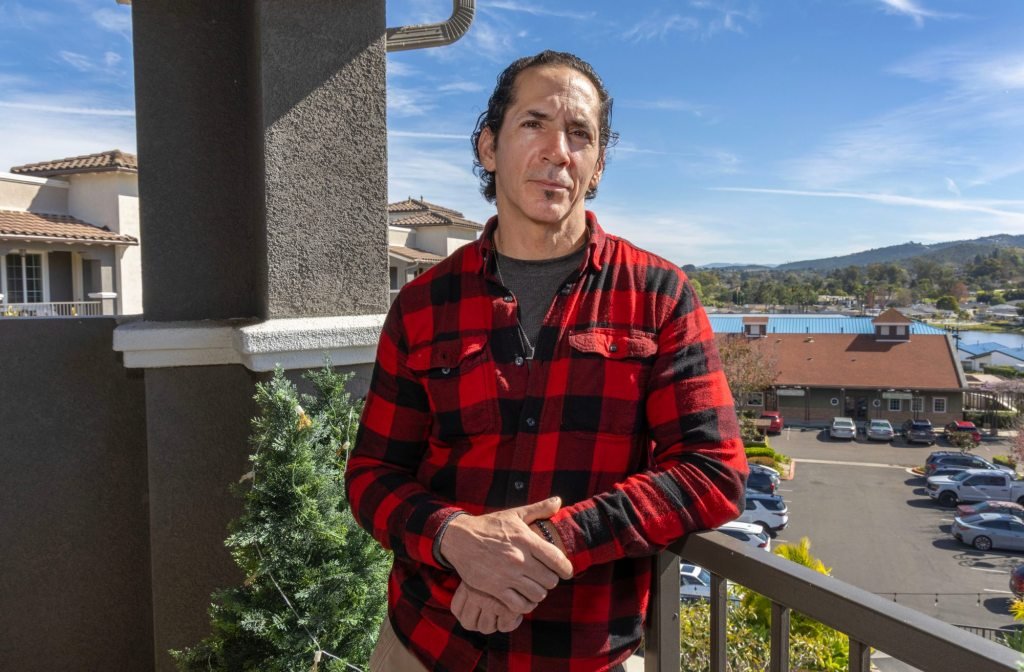
The irony of his current life path is not lost on former Las Vegas bartender Kyle Medrano.
Basking in the sunshine outside his brother’s San Marcos home, he acknowledged the obvious reversal of expectations.
“I was in the bar business for 30 years out in Las Vegas, so I catered to people’s addictions to make money; now what I’m doing is the exact opposite,” he said. “Now I can use all of that lived experience to help people not make the same mistakes as I have.”
Many peer-reviewed studies have shown that alcohol use among bartenders is significantly greater than it is in the general population. One 2024 paper, which surveyed more than 1,000 bartenders and servers, found that nearly half reported moderate to high rates of problem drinking. And binge drinking was reported at a rate “over 3.5 times more than the average American.”
Over three decades of filling drink orders in the nation’s party capital left Medrano with a need to get sober. Once he did, he said, he felt a calling to help others do the same.
“I’ve been put in a position to be able to be of service again,” Medrano said. “It’s a huge blessing; it’s a great pleasure to be able to be useful.”
To be sure, he is early in this new journey, currently working with a substance use disorder facility in Carlsbad as a registered technician, the first rung on the regulatory ladder toward becoming a state-certified drug and alcohol counselor.
And he is among the first statewide to finish ASCEND, the state’s new 80-hour online training program created by the UC San Diego Division of Extended Studies.
As a recent report from the California Health Care Foundation documents, demand for substance use treatment has increased rapidly. Emergency department visits for opioid-related illnesses — especially those caused by fentanyl — increased by 70% from 2021 to 2023.
California has put a priority on training more substance use counselors to meet this growing demand. A 2022 workforce development report estimated that San Diego County alone will need nearly 3,000 additional substance use counselors by 2027.
But there has been an effort in the California Legislature to make sure that quantity does not trump quality. The governor signed Assembly Bill 2473 in 2022, significantly broadening the scope of initial substance use counselor training. Previously, the state required a nine-hour orientation course for entry-level substance use counselors. But the new statute, implemented by the state Department of Health Care Services, requires 80 hours of instruction in the first six months on the job.
Starting in 2026, this requirement is in effect, requiring all new applicants to comply.
Previously, trainees were instructed in ethics, confidentiality and professionalism before they began working with clients. Today, entrants must brush up on the formal definitions of substance use disorders as described in the Diagnostic and Statistical Manual of Mental Disorders and familiarize themselves with classification criteria specified by the American Society of Addiction Medicine. There are now a dozen areas of instruction, including cultural sensitivity, case management, clinical documentation, medication-assisted treatment, and the co-occurrence of substance use and mental health conditions.
This is just initial training. California code still mandates more than 300 hours of instruction, half of it in a classroom, plus more than 2,000 hours of supervised work experience, and passing a written test, to earn full certification. Trainees have five years to meet those requirements.
The state recognizes three different organizations to run substance use counselor certification programs, and each must now comply with the new 80-hour requirement.
But the Department of Health Care Services also commissioned one additional option to increase the capacity for initial training, hiring UCSD to create ASCEND, a free and self-paced online program that satisfies the requirement. Short for Advancing Substance Use Disorder Counselor Education and Development, the university developed ASCEND under consultation with a special advisory group of experts in the field.
“We ran a very large peer review process with experts from all over the state to review the curriculum and ensure that it is relevant and up-to-date,” said Laura Fandino, chief academic officer and director of science and sustainability programs at UCSD Extended Studies.
Each course consists of a video lecture and ends with a quiz that must be passed to move on to the next unit. Some, she added, will have already had training in certain areas through other classes taken previously.
“They might selectively come to us to just complete one or two courses, or they could take the entire program,” Fandino said. “The program was developed so that each of the 12 courses is self-contained.
“None of the courses actually requires any prerequisite knowledge from any of the other courses.”
The teachers featured in each course also make themselves available to students, answering emails and filling office hours through video conferencing, during which participants can reach out if they have questions.
“They work in a whole variety of different settings,” Fandino said. “Some work in county behavioral health agencies, some work in health care and some work in the jail and prison system.”
Prue Cooper teaches ASCEND’s six-hour Law and Professional Ethics course. Cooper works full-time in addiction counseling with Pacific Clinics, the largest provider of behavioral health services in the state. Though she said she had not yet had an ASCEND student request office hours, she has fielded email questions since the program went live last month.
Questions tend to be about the practical application of information covered in the course material. Take what’s often called the Tarasoff duty or rule, which requires that counselors warn potential victims if a person makes a serious threat of violence during therapy.
“They might ask, ‘what do I do if I need to break confidentiality … because now I’m going to perhaps break their trust or they’re going to be mad at me,” Cooper said. “It’s quite a big ethical responsibility to be a substance use disorder counselor.”
Because of the need for counselors to be available to answer student questions, ASCEND is not open to anyone. Enrollees must apply, prove they are California residents, and show they have registered with one of the state’s three sanctioned substance use counselor programs, which puts them on the path to certification.
Overall, Fandino said that ASCEND hopes to enroll about 7,500 entry-level substance use counselors in the coming years. Hundreds have already signed up.
While there was some concern that so greatly increasing the number of hours required from nine to 80 would be a significant burden on the training system, Medrano said he found there to be no difficulty in getting the work done. Content, he noted, is available through a range of personal devices, allowing the content to be received anywhere there is a solid internet connection.
The former bartender said he really enjoyed the curriculum and found moving through the 12 courses like a book he couldn’t put down.
“We had until April to finish, but I just attacked it voraciously,” Medrano said.
Overall, he said, doing his state-mandated 80 hours of initial instruction left him feeling more confident about his decision to work toward becoming a certified counselor, especially because he is moving into an entirely new career at age 51.
“It’s truly amazing to be able to enter into something like this with no experience and now feel like, OK, I have an initial set of tools on how to help other people get sober and stay sober,” Medrano said.
Copyright 2026 San Diego Union-Tribune. All rights reserved. The use of any content on this website for the purpose of training artificial intelligence systems, algorithms, machine learning models, text and data mining, or similar use is strictly prohibited without explicit written consent.
